Olivia Sanderfoot
(she/her)
Research Scientist & Project Leader, FeederWatch
Expertise
Smoke Ecology • Fire Ecology • Quantitative Ecology • Participatory Science • Community Engagement
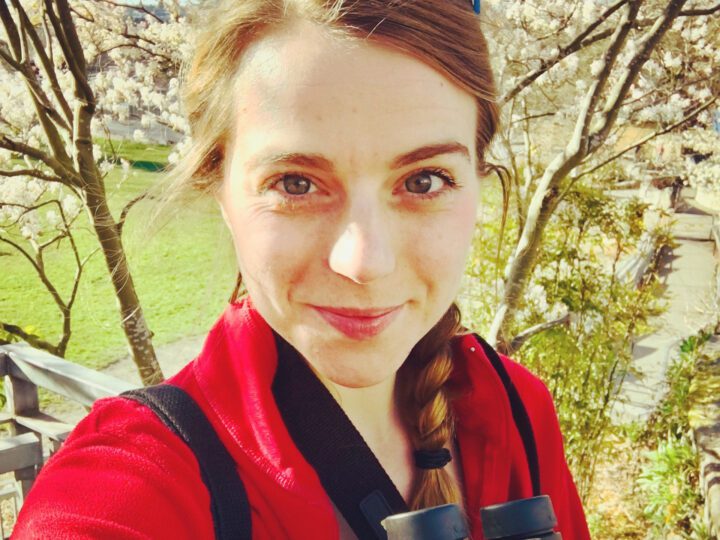
I am an ornithologist and global change ecologist in the Center for Engagement in Science and Nature. I’m passionate about connecting people to birds to further ornithological research and inspire bird-friendly actions. I believe that birding is a superpower, and all participatory scientists are superheroes.
I lead Project FeederWatch, an international participatory science program monitoring winter birds in North America. Each year, FeederWatch engages more than 30,000 people in the U.S. and Canada in counting birds in their neighborhoods during the winter months (November–April). The data they collect is used to track winter bird populations, follow winter range expansions or contractions, record irruptions, monitor the spread of non-native species, and keep tabs on disease outbreaks. Project FeederWatch also serves as a public resource for information on birds and the practice of bird feeding.
In addition to my work on FeederWatch, I’m also a Research Scientist with special expertise in the emerging field of smoke ecology. In my research, I link data and tools from quantitative ecology and atmospheric science to investigate how air pollution impacts the health and behavior of birds. Current projects leverage participatory science to examine how wildfire smoke shapes species distributions and discover what constitutes smoke refugia for birds. I am especially interested in identifying conservation actions to safeguard birds during periods of hazardous air quality.
Before joining the Cornell Lab in 2025, I was a postdoctoral fellow in the UCLA La Kretz Center for California Conservation Science and the Natural History Museum of Los Angeles County, and I’m the founder and director of Project Phoenix, a community science initiative to monitor bird responses to wildfire smoke in the western United States.
I was born and raised in Madison, Wisconsin and am proud of my Midwest roots. I’m driven by a passion for conservation, love for birds, and a strong belief in the Wisconsin Idea—the philosophy that a university’s research should be applied to solve problems and improve the health, well-being, and environment of the community it serves.
Education
PhD, University of Washington, School of Environmental and Forest Sciences
MS, University of Wisconsin–Madison, Nelson Institute for Environmental Studies
BS, University of Wisconsin–Madison, Biology and Spanish
Inspiration
Growing up in Wisconsin, some of my earliest lessons were in Aldo Leopold’s land ethic, a moral code for living in harmony with nature: “When we see land as a community to which we belong, we may begin to use it with love and respect.”
My grandfather understood this well. He was the one who taught me what participatory science was all about. In the late 1990s, my grandpa became increasingly concerned about how dairy farms were impacting local water quality around his hometown of Cleveland, Wisconsin, on the shores of Lake Michigan. Lakes and creeks were contaminated with E. coli, and many beaches were closed. The shoreline was caked in algae and fish kills were common.
Grandpa believed that runoff from fields spread with manure was polluting local waterways. But he needed to prove it. So, he founded a community science group to monitor water quality in Manitowoc County. He brought me with him to his monitoring sites, where I would help deploy sensors to test for E. coli and dissolved oxygen—my very first fieldwork. The data Grandpa’s team collected showed that dairy farm operations were jeopardizing local water quality, and empowered their community to advocate for—and win—regulations that reduced runoff. Lake Michigan is much cleaner now.
Grandpa taught me that this is the power of participatory science. To develop good policy, we need good data, and perhaps the best monitoring program is one that is driven by those who are impacted by the crises we seek to understand. Grandpa also taught me the value of finding common ground. He worked with people across political parties, across generations, across faiths, bringing them together to achieve a shared goal. I am proud that my academic career honors my grandpa’s legacy of community engagement and conservation action.