
Skip to content. Skip to navigation

BirdSleuth

Sections

Introduction to BirdSleuth

  1. Smiling kids entering data at a computer
    What is BirdSleuth?
  2. History
  3. Goals & Objectives
  4. Products & Services


What is BirdSleuth?

BirdSleuth is an inquiry-based science curriculum that engages kids in scientific study and real data collection through the Cornell Lab of Ornithology's exciting citizen science projects. Each BirdSleuth curriculum kit highlights one or more citizen science project, and encourages students do what "real" scientists do: ask questions, collect data, look for patterns and evidence, test ideas, draw conclusions, and share results. BirdSleuth modules each include a Teacher's Guide, a Reference Guide and an Investigator's Journal and resource kit materials, including an educational tool such as our BirdSleuth Focus Cards, supplemental CD-ROMs, and full-color posters.

History

The development of BirdSleuth was funded with a three year grant from the Instructional Materials Development Program at the National Science Foundation.

BirdSleuth, originally called “Classroom BirdWatch,” was field tested as a 20-lesson curriculum in approximately 35 4th-8th grade classrooms during the 2005-2006 school year. While the curriculum was very well received, its length was overwhelming for most teachers. As a result, BirdSleuth was reconceptualized as a series of modules that teachers could select depending on the specific content areas they wish to cover. 

Goals & Objectives

BirdSleuth is a supplementary science curriculum. Its main goal is to engage students in inquiry. Students get curious as they observe birds while collecting data for one of the Lab's Citizen Science Projects, and learn to ask and answer their own questions about birds through original observational data. The curriculum supports educators in conducting authentic inquiry and aligns with most of the National Science Education Inquiry Standards for both learning and teaching for grades 5-8 (National Science Board 1996).

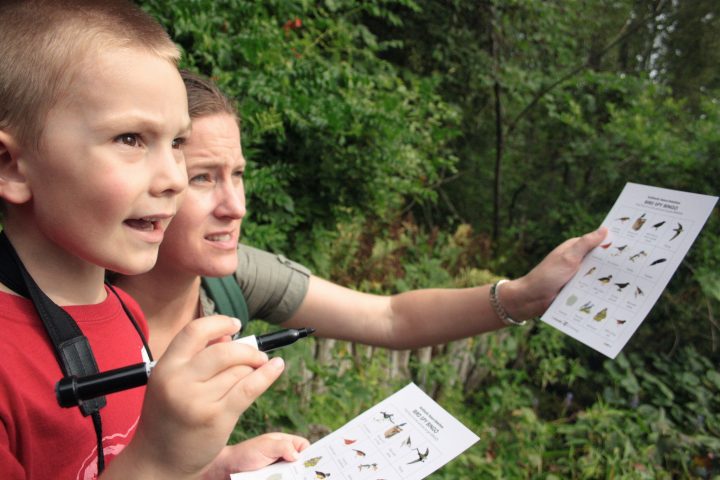
kids on benchTo help involve students in inquiry, BirdSleuth scaffolds several of the Cornell Lab of Ornithology (CLO) citizen science projects, in which participants collect data to help answer important scientific questions in partnership with CLO scientists. By participating in citizen science, students become an integral part of the scientific process as they do what “real” scientists do: ask questions, collect data, look for patterns and evidence, test ideas, make conclusions, and share results. 

BirdSleuth offers the opportunity for students to:
•    Ask and answer their own questions about birds (inquiry!)
•    Go outdoors to study their local environment
•    Get involved in birding, perhaps even develop a life-long interest
•    Become citizen scientists and collect data for CLO's online databases; use real data in a meaningful and motivating way
•    Learn to think more critically and become better equipped to make scientifically sound decisions

Each module and lesson plan has specific learning objectives.


Products & Services

MWB: All Printed CoversCD SpreadCurricular Materials
BirdSleuth is a series of printed modules that scaffold several of the Cornell Lab of Ornithology’s Citizen Science projects:
•    BirdSleuth: Most Wanted Birds (eBird)
•    BirdSleuth: Exploring Bird Behavior (Crows Count, CamClickr)
•    Science Investigator's Kit for Homeschoolers (Project FeederWatch)
•    BirdSleuth: Investigating Evidence (A free, online module that scaffolds all of the above)

BirdSleuth: Most Wanted Birds was released in October 2006.  It includes a teacher lesson plan, student journal, reference guide, and a resource kit that contains resource pages, a set of 36 full-color focus cards to assist students in learning bird identification, a common feeder birds poster, and two CD-ROMs (one containing an interactive Bird ID quiz, and the other containing resource materials for teachers).

BirdSleuth: Exploring Bird Behavior is BirdSleuth's second module, and in Fall 2008 was revised to include additional Investigations, a brand new Investigator's Journal, new resource pages, a set of tools for conducting behavioral experiments, and a revised CD-ROM. This module focuses on bird behavior and animal intelligence and introduces students to ethology, or the scientific study of behavior. Investigating behavioral questions allows students to explore a new field of scientific research.

The Science Investigator's Kit for Homeschoolers is BirdSleuth's newest module. Released late 2008, this homeschool module is designed to serve as a complete biology curriculum for students at the 1st-4th grade levels. Scaffolding Project FeederWatch, the curriculum guides students and parents through bird biology, backyard ecology, and bird behavior during the winter feeder season. While supporting long-term observation during the feeder season, the module also encourages inquiry-style research by asking students to look for long-term patterns. The module includes a guide to backyard birds and a bird log for recording regular observations.

BirdSleuth: Investigating Evidence is a capstone to each of the modules. Available online at no cost, it supports teachers in conducting inquiry in their classrooms. It includes a growing repository of lessons, linked resources, and teacher supports (such as rubrics, vignettes of classroom inquiry, and tutorials). In the future, features such as an online forum will also facilitate the building of a community of teachers who can interact with each other and with Lab staff online. 

Other Materials
Focus Card HummerA set of 36 full-color focus cards is available in an Eastern or Western version for $14.95.

We also serve as a distributor for Pocket Naturalist Guides ($5.95).


Teacher Professional Development Workshops
While the curriculum is easy to use, some teachers prefer to be trained in the use of the curriculum, and such training is likely to assist them in fully using the curriculum. Teachers often need professional development (continuing education) credit, and schools, districts, and science institutions seek out training opportunities for their local teachers. The BirdSleuth team provides workshops to groups of teachers (2 hour, half-day, full-day, and multi-day trainings are possible) on a fee basis


Need help finding funding for your various birding projects? Click here for some ideas and resources we've compiled to help out!

facebook_clickover
Join our email list:


NSF
This material is based upon work supported by the National Science Foundation under Grant No. 0242666. Any opinions, findings, and conclusions or recommendations expressed in this material are those of the author(s) and do not necessarily reflect the views of the National Science Foundation.