
Women in STEM
To celebrate Women’s History Month, we’ve put together a series of blogs based on interviews with four talented women of color who are pursuing careers in STEM. Join us as we celebrate these women and acknowledge the complexities, struggles, and beauty of being a woman of color in STEM.
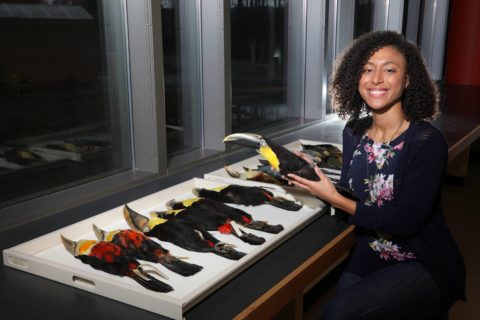
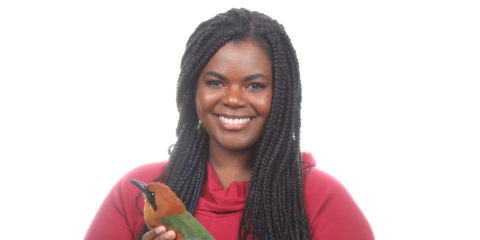
Meet Amelia-Juliette Demery, a former Ph.D. student at the Cornell Lab of Ornithology.
Amelia’s interview gave us honest and raw insight into the realities of Black women in the workplace, particularly in ecology and evolution, and the importance of mentorship. Her eloquent words leave a lasting impression that challenges us to reflect on the often-overlooked intersection between race and gender.
Amelia is working toward her Ph.D. in an evolutionary ecology lab. She is interested in why different organisms look the way they do. She became interested in biology and ecology during her undergraduate years at California State Polytechnic University where she studied survivorship in fence lizards within urban and rural environments. From there she made the leap to birds, looking at broad-scale evolutionary patterns of beak morphology for tanagers, one of the most diverse groups of songbirds. Her current projects are focused on beak color in birds, which can communicate health, dominance, and even sex appeal. She studies one of the most common birds on our planet: European Starlings. Starlings are especially interesting because they change their beak color throughout their life: in the breeding season, they have bright banana-yellow beaks but in the non-breeding season, their beaks turn black. To understand what triggers these changes, Amelia puts starlings into an experimental setting and tries to trick them into changing their beak color. So far, the experiment revealed that changing beak color in starlings is not related to hormones. Now the question shifts to what genetics factors are at play, and how are they connected to other aspects of starling life history.
Below is a partial transcript of her interview describing her experiences in a predominately White field. It has been edited for clarity.
Oh definitely telling stories. A lot of my hobbies are in telling stories or just getting that adrenaline rush of just not knowing but wanting to find out anyways. And then being able to synthesize it in a way that excites people, and make them want to ask more questions… my success is really directly correlated to my level of excitement and just having a good time. No one else in my lab is doing this kind of stuff—I’ve never done this stuff ever in my past degrees. So it’s that kind of excitement of like ‘Whoa I get to just jump in and figure it out’ and then I get to tell people about it.
I’ve only first authored two papers right now so I’d say most of my experience in storytelling comes from going to conferences… I have way more fun talking about science to people who are not a part of science or at least didn’t grow up with science because I didn’t grow up with science. I got really excited about science once I was just exposed to it and someone wanted to talk to me about it in a way that would capture my imagination. I think that is more of a challenge due to the academic bubble. It’s so easy to get stuck in the jargon all the time and it’s hard to jump out of that, but jumping out of that is very refreshing.
Oh no. So my mom doesn’t even have her GED, she’s actually going back to school this year to get her high school diploma. She comes from a small farming village in France and then she immigrated over here not knowing a lick of English. My dad was an academic, but he wasn’t in my life. When I was like 13 [he passed] from cancer… But he was a wine salesman and so my dad was probably the closest person to me when it comes to higher education. But there’s no one around in the natural sciences. I didn’t even hike until I went to college. The only thing that inspired me was literally Animal Planet.
It was just wanting to go out somewhere and be able to be Steve Irwin and just talk about snakes and be in khakis. So when I wanted to pursue a career in STEM, it was my ornithology class in my junior year of college and being really inspired by birds. Not because I’m a bird nerd; it was more like “Oh my god look at how all these people react to birds, like you could really use this to really do some good.” Because everyone has access to it and everyone really connects to birds in a way that they may not connect with other animals. Then my professor, Dr. David Moriarty, was one of the first people who didn’t come from my background, was a position in authority, and really wanted to develop my interest in birds and made me feel like I could do research and I could get paid to do research. So my undergraduate work with the lizards was through my undergraduate advisor Kristopher A. Lappin where I took his herpetology class. It was my first time being like ‘Oh wow I can get to work on this project. I could get paid to do this. All right let’s try this out’… I didn’t get the confidence that I have now until I was in my third year of my master’s. Having the people who not only you can model after or be like ‘Wow I kind of want to be like them’ but make you feel like you have these strengths and you should really pursue them instead of just being this unachievable dream. I really think that back and forth communication and support are really important. I was really fortunate to have that, not so young but to me, it was really timely.
Monique had just had a conversation with her advisor about safe fieldwork practices and she had called me and asked what I did to be safe in the field. We were trading our experiences and just saying like ‘you know it really would be important if we made this for our department” and so we went to our respective advisors. My advisor sent me a paper about sexual harassment and said “you know if you’re going to talk about being a minority in the field, sexual harassment is also a conversation that occurs too and you folx should think about this.” So we started working on something that was originally just supposed to be for the department and then through our professional networks we solicited feedback. We got so much feedback from other students and from our department that we decided there’s an opportunity for us to really make an impact for a lot more people than our bubble, so let’s just go for it. It turned into this very universal paper stripped of all institutional specificities so that this could be something that someone could put in their lab resources document and just mandate that everyone in the lab reads to facilitate that conversation, but also send a signal of intention without the pressure of ‘who am I excluding by including,’ because this is for everybody.
First off, thank you for addressing intersectionality because I think when we essentially walk into a space where there’s some kind of institutional practice or language about diversity and inclusion there’s rarely any intersectionality that’s acknowledged or appreciated. I definitely think there’s some challenges with the intersection of that. I’m mixed and I’m Black; in America my mother’s heritage would be White but I didn’t grow up feeling White because my mom’s an immigrant from poor France, not even like Parisian France. So I’ve had a lot of things like walking between different worlds or being perceived as passing for another identity or being the darkest person in the room, and how all those dynamics create lots of different situations.
I’m just going to focus on the challenges in my space right now, for my workplace I haven’t been the first person of color in the space but I’m definitely the first Black person. A challenge is being able to feel that support without asking for it, and without advocating. Especially as a woman of color that pressure has been on our shoulders for any type of advocacy and continues to be with no credit or just some awkward conversations.
It’s different pressure; in the workplace talking about DEI (Diversity, Equity, and Inclusion), it’s uncomfortable. Or having to vent but with that back thought of ‘Is this person going to vomit some White guilt because I’m trying to vent, and is that worth me venting right now’ or should I just go home and just scream at my best friend who understands. My field site is at Hartford, New York which is like 25 miles away from campus, but when I drove through a back road because I wanted to shave two minutes off my commute, I saw a heritage site and looked at the sign and it’s a mass slave burial site. I look around at different local insignia and I can put two and two together and think about how these people might have been raised or the culture they come from– I’m never driving down this road again. And the follow-up question is: who can I talk to about that? And actually have a deep conversation where they want to dive into it and come out with some solutions. There’s really not a lot of people that I can do for that. During the protest last year, Monique and I really leaned on each other talking about this stuff because she was the only person that I could talk to. I’d never had a person of color that I could speak to this freely even growing up too because my dad passed away. It was crazy to feel like some door had been opened and so the challenges are chronic. Sometimes it can be really microaggressive, sometimes it’d be really severe like seeing the sign.
Absolutely because the sense of what research should be pushed and what is considered novel is highly dependent on who did it first. A lot of the time for research that is seen as “too niche” it is because it’s looking at a different society, a different culture, a different demographic. And it’s like ‘oh well that has been done before’. No, it hasn’t been done before because there’s a lot of evidence that proves that these results vary by species and birds. It’s going to vary by demographic in humans because we’re so diverse. Then when we think of mentorship there’s not one good way to be a mentor, especially if you’re seeing everyone as the same. My advisor is of the generation of many advisors who are used to having one type of student. They’re White, male, privileged and you change any one of those and all of a sudden there are different challenges. To his credit he leaned into and is growing from it but I consider him an outlier. For most people of any minority identity, whether it’s easily visible or not visible— like a disability or an expression orientation— there’s just that isolating factor that is just chronic all the time because STEM is so homogeneous.
You just have to persist through it and you have to ‘work twice as hard for half as much’. When I grew up with that I was thinking to myself like “Oh it’s only because like I’m Black and I’m not gonna have a fair fight. I just have to work harder’ but I think it’s also the additional mental strain. You’re really trying to hit a status quo that a lot of people can reach easily because they don’t have to think about this every night. They don’t have to judge how their actions are going to be interpreted. The amount of times I have to think to myself ‘Okay when I read this email, do I sound angry? I think I sound direct but how much of this is me trusting that the audience on the other side doesn’t have these biases?’. I think the challenges are huge and for people of any minority identity or combination of identities, they’re like numb to it. The shock comes from someone who has that privilege.
The change needs to be top-down, so that if someone wants to have a comprehensive mentorship style, inclusive thinking, and consideration… in these positions of power… that’s not only expected, that’s required. Some institutions have required diversity statements for faculty or for students and I think there needs to be more than that. There needs to be concrete evidence and requirements for getting funding, not just for specific individual labs but for entire institutions. If they want to get some of this federal funding they need to have things in place that promote recruitment but also retention instead of just throwing money at people and then expecting them to just figure it out, or be happy that you’re at an Ivy League. That doesn’t mean anything if you want to leave as soon as you graduate. So I definitely think we need some top-down accountability to know that there is a safety net for the people who want to get a foot in the door instead of just helping them get their foot in the door and then walking away.
So there’s a podcast I listen to called “Hidden Brain” and it goes into how people think, but why they think that way. It is very soothing and has really helped me with just processing just why the world is so bad. I experienced that with my mom because I have four degrees more than my mom right now. There was a time when I – a graduate student – was making more than my brother and my mom combined. For BIPOC students more often than not the parents may not fully understand what those students are going through. Listening to that podcast there’s a realization that could be better communicated between both of them [parents and students] to keep that love there and keep that support. So many students are coming into STEM thinking it’s this objective, progressive place and it’s usually just worse and no one tells them because their mentors don’t look like them.
First of all, teachers just deserve to get paid more but they really have a responsibility to be so much more than just an hour-long lecture. As a TA at San Diego, there’s some times where I had to really check myself and think ‘what is that person going through’? And more often than not they were going through some serious stuff, and at Cornell it’s no different. It ties to this kind of threat of isolation that I’ve been talking about. BIPOC students are raised to work a ton, to not expect as much, and to do it on their own because if they try to get help then that’s another type of stereotype threat against them. If they do have friends more often than not there’s going to be some type of awkward conversation because of differences and the tumult that’s like going on right now. I think teachers are at the front edge of really learning through exposure, one-on-one time, and just through a need to really be there. It’s inclusive teaching, it’s not just students who need to learn how to interact in that diverse classroom. Teachers have to do that too and there’s a power dynamic. I’ve had teachers who have said some things that stick with me like my calculus teacher telling me ‘I know you can do better’ and it was that tough love and empowerment. Or like Dr. Moriarty in Ornithology, where of all the people, some of whom looked a lot more like him, I definitely was getting special treatment because he knew that I could do something more. He was one of the first people I told I got into Cornell… especially for someone who’s BIPOC, they don’t have someone who’s been encouraging them since they were six, who’s been telling them they can do things. They haven’t been seeing people who look like them doing those same things. Teachers have this really incredible but equally weighty opportunity. The odds are they’re not going to be coming from the same background and it’s an insane amount of power that they should leverage to be supportive. It’s incredible to see what someone can do if you just give them that encouragement or at least let them know that they don’t have to figure things out alone.
There’s a last song in Logic’s latest album called “Obediently Yours” and there’s a steady beat, momentum, and tempo in the words that are just ‘what you have, you use for the good of people who have less’. The stuff that I like to do, I always want to share it so for people who might read this and take some form of joy out of it: my creed is that ‘what I do I’m doing for the next generation after the next generation’ and it really empowers me to put my all into it knowing that I will probably never see the actual results and that’s okay because I’m not doing it for me. I’m not doing it so I could bear witness. It’s knowing that something will come of it.
[Last few lines of the song:
Our children’s children are the ancestors of a free people
To the generations: the fight is worth it
And that just about means that my time is up
When my time’s up, I remain as always, obediently yours]
I listen to that driving from the field and just be like ‘yeah this is why you’re doing this.’
If you are interested in reading Amelia and Monique’s paper about safe fieldwork practices for minorities, you can access it here.
Additionally, Amelia and Monique hosted a webinar regarding their paper that also featured a discussion with interdisciplinary professionals in fieldwork, diversity, and inclusion. Watch a recording of the webinar here.
Thank you to Amelia for being willing to share her story, and to Cornell Lab student employee Victoria Varlack for conducting the interview and writing this post!

Meet Dr. Irene Liu, a Story Researcher and Associate Producer at the Cornell Lab of Ornithology.
Irene’s interview spoke to the importance of working toward inclusivity and equity in the workplace in addition to diversifying staff and faculty. She poignantly expresses how the undoing of structural racism is a collaborative effort that requires commitment from everyone involved.
Irene currently works at the Lab’s Center for Conversation Media. The Center’s mission is to use the power of targeted media to help conservation partners advance their initiatives. She provides research support and helps ensure films are scientifically accurate. She first earned a B.A. in Spanish Language and Literature and a B.S. in Zoology at the University of Maryland, College Park. Afterward, she pursued a Ph.D. in Biology at Duke University. Her interests in science and communication have brought her to her current position at the lab.
Conservation Media’s model is very impact-driven. We find partners or partners find us, from within the U.S. or across the world. Partners are on-the-ground conservation parties that are doing their own campaigns which might benefit from communications resources. We learn about the audiences they’re trying to reach and the outcomes they’re trying to achieve, and then we work with them to co-design that media according to their strategic communication plans. I enjoy making these focused, tangible products that I know will be seen by their target audiences.
I really like that I get to work with people who come from all different fields of expertise. My coworkers have worked at places like Sesame Street, Discovery Channel, and the feature-film industry. We all understand the material differently, and it’s been really nice to learn from them, especially coming from a specialist background and training.
Irene gives more insight into the process of communicating science to audiences in an effective way.
My former colleague used the phrase “narrative transport,” and I instantly knew what she meant. When you’re experiencing something with a narrative component, there is empathy that comes when you really delve into a world and its characters, real or fictional. Even if you’re consuming a short piece, you’re briefly immersed in that mindset or in those issues, and you have that temporary investment. You want to find out what happens.
We always try to have a call to action at the end. So if you found yourself responding intellectually or emotionally, you know there’s something you can follow through with.
The other part about narrative power is that we’re often talking to people who haven’t read the scientific literature. So bringing in elements like data visualization can help people understand how much range a species has lost or how its population has declined. We’re able to bring that science in a pretty readable format to audiences that might not have seen it otherwise. That’s the narrative. It’s science, but you’re communicating it in a way that is easily understood by the people you’re trying to make sure know about it.
When I was 12, a male Northern Cardinal landed in a bush that was very close to a window in my house. I was like, oh my gosh! I knew what it was, but I hadn’t really seen one so up close. I come from academic privilege—my parents are both teachers—so they had a lot of random books around for me and my brother to read. One of them was a Golden Guide to birds. Nobody in my family was a naturalist, but the book’s presence meant I had a resource to start learning about birds. And as I grew up and decided to study science, the access and the opportunities were there. I started my research career in college and had two very influential senior thesis co-advisors. They opened doors for me and invested in me as a scientist. That was super pivotal.
I’m actually going to say no. I thought about why I haven’t had a lot of barriers or at least why I haven’t perceived them, either as a person of color or a queer person. Coming from academic privilege, I have that capital that allows you to belong to a community like the one at the Lab. The way that I speak, my immersion in the ornithological field, the skills and the interest I brought fit with the dominant culture. But I am aware that not everybody who is at the Lab or really any workplace finds that sense of belonging. Another factor is that I’ve always worked with supportive people. I’ve not gotten any messages from managers or colleagues remotely like “you don’t belong here because of your race or your gender or your sexuality.”
There’s some intentional choice too, because as a queer, interracial couple, my spouse and I definitely thought about places where we did and didn’t want to live. And then there are structural factors like having access to good health insurance and access to personal finance resources. The stuff that gives you foundational security and lets you focus on what you’re brought here to do. Sometimes it feels like I threw a lucky roll of the dice, and that bothers me because it shouldn’t have to.
I find great meaning in doing DEI [Diversity, Equity, and Inclusion] work, and I treasure the relationships and opportunities that come from this work. But I also know about the greater trend that there is an imbalance in who’s doing the labor. Frequently they are people from underrepresented communities. You want to make sure the people doing this work are supported and don’t feel alone in their efforts. And you want to get outside help, as I’m proud of the Lab for doing, to provide expertise that no one here has.
I think the Lab is at a crossroads of trying to translate words, intentions, and commitments into action. Of course the action is the hard part. There are risks we have to take, and we will be uncomfortable. Different people have different risk thresholds and different understandings of the issue and ways of approaching DEI practice. Everybody, including me, needs to be more open to listening to those perspectives because they’re very closely held by each person. You have to work from a space of trust so that people react with inquisitiveness and not defensiveness. So that’s why the dialogue is important, but at some point, you also need to shift to action. The Lab needs to hold itself accountable for both top-down and bottom-up cultural shifts.
I thought about that from a couple different ways. A practical one is to encourage them, just like you would encourage anybody who shows an interest in something that you know about. I would consider it self-evident to give any student access to networks and opportunities. Help them with the resources that you had access to, because it’s all about paying it forward.
The other prong is—this is not just parents and teachers—gaining and applying knowledge of colonialism in Western, European-derived science, and understanding how the foundations of our success has rested on a system that benefits some people and not others. Being aware of all of the levers that have brought us to where we are. Practicing answering the negative-space questions, like “Who’s not in the room? What questions are not being asked?” Being aware of that and modeling that you’re understanding that part of DEI practice helps to make the room inclusive for everybody, especially BIPOC students.
For a peek at the awesome work that Irene creates, take a look at this powerful collection of personal testimonials from Black, Indigenous, and Latinx ornithologists from the 2020 North American Ornithological Conference. In each video, individuals answer questions such as “How do you envision a more inclusive and equitable ornithological community?” in a candid and impactful way.
Thank you to Irene for being willing to share her story, and to Cornell Lab student employee Victoria Varlack for conducting the interview and writing this post!

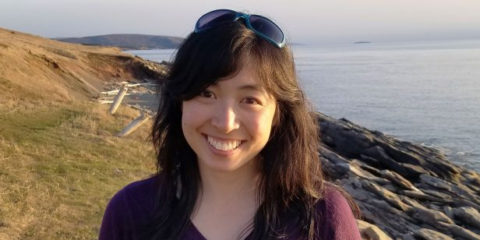
Meet Monique Pipkin, a former Ph.D. student at the Cornell Lab of Ornithology.
Monique’s interview gives us valuable insight into her experiences as a black woman selecting a graduate school, working in the field, and navigating the workplace. Her powerful words invite us to consider how each of us has a stake in making STEM environments safe and uplifting for women of color.
Currently, Monique is a Ph.D. student in Maren Vitousek’s lab at Cornell University. She characterizes herself as a behavioral ecologist who dabbles in physiological ecology, looking at the drivers and outcomes of feather coloration and adaptive functions of feathers. Recently she has been interested in exploring how song and feather coloration function in bird communication. She spent her undergraduate years at Western Michigan University where she did sound ecology research about how Chipping Sparrows and House Wrens respond to human-produced noise. She also worked on a project about treatments for white-nose syndrome, a fungal pathogen that’s ravaging bat communities. During her Master’s degree at Penn State University, she studied how physiology affects behaviors. She is on track to defend her dissertation later this year.
Below is a partial transcript of her interview describing her experiences in a predominately White field. It has been edited for clarity.
I think it’s that I like puzzles for the sake of puzzles. When you go out on a walk, you can look at an animal or a bird or a squirrel, whatever’s in your backyard, and you can ask yourself the question “Why is that animal behaving that way in this location at this time?” And the answer to that question could be different depending on the animal you’re looking at, the time of year, the time of day. It’s just fascinating to understand the world around you and I’ve always been interested in that. So it’s kind of understanding or learning for learning’s sake is what really drives me. That, plus I love getting really excited when you realize that someone has a finding and then seeing the domino effect of how many other people that got inspired by that finding. That’s also a very exciting feeling to “Oh my god! you got inspired by this person, who got inspired by this person, who got inspired by this person, who got inspired by this person.” Or you saw this talk and now you have all of these ideas and now that undergrad is a professor here. All of those exciting tracks to see not only how science progresses throughout time but with how people can be affected and inspired by the past work. All of that is such an exciting pathway to follow.
Visiting the Cranbrook Institute of Science in Bloomfield Hills, MI, my local natural history museum, definitely influenced my pursuit in STEM. My parents are from New York City and they are not what I would call “outdoorsy people.” So I got into nature or the natural world really through watching Animal Planet, Magic School Bus, Steve Irwin, and Zoboomafoo. My entry point was never “Oh we went camping every week!” It was learning the bugs in my backyard with the flashcards that I had. It was my mother indulging me and understanding “Oh, she really likes this so I will spend my Friday evenings at a natural history museum, again.”
It started with a question where I asked Amelia, “What do you do to stay safe in the field?” We began to write guidelines just for our department but we had people of different identities and at varying professional stages review the guidelines. These colleagues began to ask, “Will you publish this somewhere? Can it be somewhere more accessible?” Our advisors said the same thing, so we made it into a preprint. During this process, Nature News contacted us to speak about our efforts and that was the encouragement we needed to officially submit our paper.
Ecology and Evolutionary Biology has started to implement the suggestions we made in the paper. Based on what I’ve seen on social media from people’s responses to our paper and webinar, many departments now have begun a conversation about field safety, and are creating safety plans and codes of conduct. It’s really encouraging to see that so many people are thinking about field safety now. We can track metrics of a paper and I remember from very early on it has been shared on every continent minus Antarctica, at least once.
If you are interested in reading Amelia and Monique’s paper about safe fieldwork practices for minorities, you can access it here.
Additionally, last month Amelia and Monique hosted a webinar regarding their paper that also featured a discussion with professionals in fieldwork, diversity, and inclusion. Watch a recording of the webinar here. Almost 1000 people attended the live event!
I think my biggest fear was that no one would care what two graduate students had to say about field safety, but having those four panelists [Dr. Hendratta Ali, Dr. Meredith Hastings, Dr. Christopher J Schell, & Sara Souza] corroborate what Amelia and I wrote, and share the actions that they’re taking to be safer in the field. I recall Meredith Hastings posing to the audience, “Can we change norms in the field to make people feel safer?” Christopher Schell shared he set aside money to hire multiple people so that people weren’t alone in the field. The panelists reinforced what was in the paper with their own experience and expertise. Their contributions made me feel more confident and legitimized the work Amelia and I have been doing. I believe now people can implement the strategies that we’ve suggested.
I think the reason why it’s had so much of an impact is because people want to help, but they had no idea how to start. So our paper was a quick guide of things you can start doing right now. You can just start making changes today if you decide to do so.
Currently, there are plans to write a follow-up paper with our panelists to address some of the questions or themes from the dozens of questions we were unable to address in the webinar.
Honestly, no. I probably should have considered that. I think my concern was us not being trusted or our suggestions viewed as legitimate because we were not doctors or professors. But it’s interesting when writing this paper, I wasn’t really thinking of myself because I know if I go into the field I could deal with situations on my own—if something bad happened I feel like I could handle it, but I want to make sure that no one has to deal with the struggles that I have faced. When I think about my “little” cousin, who is now a teenager and loves birding. We’ll talk about it sometimes. I get so excited and then also so scared. All I want to do is make the culture safer so those behind us can come up in a place where they can have an equal starting place when it comes to fieldwork and know what it’s like to go out to a field site, how to be prepared, what to expect out there, what’s okay, and have people warn them of any type of potential issues or how they should go in groups because you don’t know the people around you or how to report issues if someone in your own group even is harassing you.
One thing I would love to change, and this is across the board at institutions, is this idea that just because we’ve done something one way, we should keep doing it in that way. Tradition is no reason to continue a behavior or continue a pattern or continue a methodology if it can be improved upon. If an institution is not getting the increased diversity or retention, you’re seeing that something is wrong with the process. I feel like that it’s really what encompasses a lot of things, which either people are resistant to change, or think “I’m not the problem”, or think it’s because ‘oh we’ve done it this way so it should be fine, or well let’s just increase numbers and increase funding and that will solve all of our issues’. No, the entire way the system has been brought up is faulty. As Amelia said on Wednesday [in the webinar], it’s a colander that has systematically excluded individuals so we need to change the process to actually make it a safer environment that is more accessible to everyone.
COVID makes everything difficult, but I will say there are definitely programs out there, especially for K-12, right now that are trying to help Black and Brown kids go out into nature. I think of Outdoor Afro, but find the programs in your area and find the camps. Just let them explore nature and go out with them, that means a lot too! I remember the first time I took my dad on a walk in nature. He bought a walking stick and I said “Dad, we’re in a park that’s just not manicured, you don’t need a walking stick.” It was an exciting moment to go and try to sample some plants with my family for a class. The best advice I would say is just encourage them, go with them, let them ask a lot of questions because asking questions is like the bread and butter of my entire career. Being inquisitive and persistent is fantastic!
Know that there are scholarships if you want to get your child or students of any age into camps or programs. Apply if you feel unqualified and even when you don’t think you will be selected. I applied to scholarships and I got to where I am.
If you want to diversify your classroom, there’s an entire list that Corina Newsome has put up about the people, specifically Black scientists, who’d be happy to talk to your high school or to your kindergarten class.
I will say being a woman doing fieldwork alone is inherently scary because if you are approached by a man in the field you tend to be physically smaller. I have had friends and colleagues who have been approached in the field by men, even ones who did not intend to do any harm. It is an instantly terrifying moment because if they decide to do anything, you could be physically overpowered. One way I try to mitigate this issue is that I try to always be in the field with someone or at least check in with someone so they know where I’m going to be at any given time.
Being Black and doing fieldwork no matter where you are is really scary because, as someone from the 1920s said, these pristine landscapes were not made for us. It’s all the history of Black people in nature. We’ve been out there forever, but it’s [scary] going out there alone in predominantly White areas in rural environments. While I lived in college towns for my research career, the areas around my field sites have not always been welcoming. You don’t see the Black Lives Matter signs you see around downtown Ithaca. You can see Confederate flags. You can see signage of political parties that show that you’re not welcome. And it is intimidating. It’s scary when you have a police officer all of a sudden do a U-turn after they see you and pull into your site, and then drive away moments later. That happened to me this summer. It’s nerve-wracking when you have to approach people and tell them they can’t be on certain property, and they respond that they have permission. Who am I to them? And especially in an area that they may feel more of a right to because that’s their community and I’m an outsider. Not only because I don’t live there, but because I also look so different from everyone else in that community. So Black people in nature and Black people outside alone are outsiders in many respects. I don’t want to even have to quote all the police stories about what happens with vigilante “justice”, with police pulling you over and ‘oh no something happened in jail we don’t know what about’, I’m talking about like Sandra Bland in that case. Talking about Ahmaud Arbery who was out running, people followed him, and then murdered him. Everything from society plays into what you do in the field, and you are leaving the safety of your bubble when you’re going out into the field.
In terms of a workplace specifically, I have worked very hard at finding places that I knew would accept me. I have been told I ask very difficult questions when I was interviewing for grad school. I was never going to only ask faculty to tell me about their research. I want to know about scandals or tragedies that happened at the institution and how it was handled? Now, let’s talk about diversity here. I always find one of the few Black people, and ask ‘how is it to be Black here’? You would find someplace quiet to talk and people would tell you. Then when going to Cornell I was excited to see more than one black person in this department. It’s also sad but when you go to predominantly White institutions, you are so excited to see someone else who looks like you, who does the work similar to what you do, in any aspect, in any way. But you have to ask difficult questions early on. It’s important to know that you are not only interviewing the institution, but also interviewing your peers.
I will say it’s frustrating when you are asked to do all the diversity and inclusion work because you are a diverse person. I’ve been advised at conferences to ask if workplaces will add to your workload by assigning you all DEI efforts which can be a distraction from the work you were hired to do and an uphill battle to make change, if you are a junior member of the staff. There are consultants who have made it their job to train and implement change and I hope institutions would use these firms to make change.
If it was perfect, when challenged everyone would immediately say “ I had no idea what I was doing. Let me change my behavior right now.” My perfect world can happen. After people are challenged they’re likely going to be hurt by seeing injustice that they’ve been perpetuating themselves in ways that they were unaware or believed to be inane. Yet then they would rally and consider “Well what can I do right now to make it better?” All you have to do is try now. It’s not gonna be perfect on day one and don’t expect it to be, but don’t wait to make change until it’s perfect. It’s gonna be imperfect—come to grips with that. Throughout your life you will continue to be corrected when you make mistakes even when you’re trying, and you should take it, accept it. Then say all right let’s change it, let’s try again and do better the next time. It’s a continuous process, just like how science is a continuous process. Someone starts, you add on, you improve, someone else says oh well this is interesting but I don’t find it in this system or whatever else, but it’s a continuous process that you keep building upon. So just start now! Action today—this is what I would love to see right now! And changing of hearts and minds, but that’s harder to do. It always bothers me because you [White people] have so much more power than I do—I cannot reach the people you can reach because they might not listen to me, but they will listen to you because they know who you are and they trust you based on your identity, so use it! I don’t pass. I can’t go behind closed doors and I cannot recommend they change their behavior or actions because they don’t want to hear from me.
COVID makes everything difficult, but I will say there are definitely programs out there, especially for K-12, right now that are trying to help Black and Brown kids go out into nature. I think of Outdoor Afro, but find the programs in your area and find the camps. Just let them explore nature and go out with them, that means a lot too! I remember the first time I took my dad on a walk in nature. He bought a walking stick and I said “Dad, we’re in a park that’s just not manicured, you don’t need a walking stick.” It was an exciting moment to go and try to sample some plants with my family for a class. The best advice I would say is just encourage them, go with them, let them ask a lot of questions because asking questions is like the bread and butter of my entire career. Being inquisitive and persistent is fantastic!
Know that there are scholarships if you want to get your child or students of any age into camps or programs. Apply if you feel unqualified and even when you don’t think you will be selected. I applied to scholarships and I got to where I am.
If you want to diversify your classroom, there’s an entire list that Corina Newsome has put up about the people, specifically Black scientists, who’d be happy to talk to your high school or to your kindergarten class.
My biggest thing that I would end with is: do what you can now and then confront behavior when you see it, especially if it’s somebody who you are close to. Dr. Hendratta Ali said that at the webinar. If someone you know is doing something wrong, it is going to be uncomfortable but you need to point out bad behavior. So doing what you can right now, in the moment, because all of that action, even if it’s a small step, is progress and important.
Thank you to Monique for being willing to share her story, and to Victoria Varlack, Cornell Lab student employee, for conducting the interview and writing this post!

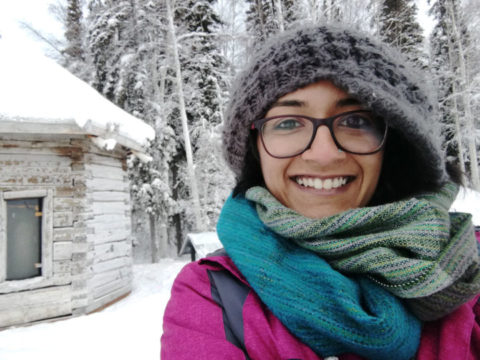
Meet Dr. Anusha Shankar, a Postdoctoral Fellow at the Cornell Lab of Ornithology..
Anusha’s interview gave us unique insight into her life as an Indian ornithologist. We discussed everything from her upbringing to her hopes for the diversification of her field. Hearing Anusha’s perspective allows us to acknowledge the resilience and talent she holds while also reflecting on the ways in which race and gender affect how people experience their careers.
For nearly the last decade, most of Anusha’s work has been studying energetics in animals, such as hummingbirds and rodents. We asked Anusha to tell us about the path she took to her science career. She went to many schools as she grew up, which she credits giving her an outgoing personality. She got her Bachelors in Zoology in Chennai, her hometown in India. Then stayed in India to do a Masters in Ecology and Environmental Sciences at Pondicherry University, before coming to New York to do her Ph.D. at Stony Brook University. After graduating she did a postdoc at the University of Alaska Fairbanks, studying diurnal rodents and how they got seasonally depressed, before moving into her current postdoc at Cornell Lab of Ornithology, studying how hummingbirds use torpor to save energy at night. Anusha is interested in how her studies of animals might impact human health, for example, for understanding seasonal depression and cryotherapy during surgeries.
Below is a partial transcript of her interview describing her experiences in a predominately White field.
During the pandemic when I’m stuck at my desk it’s really hard to always remember this: but I love being outside. I was in the field once in Arizona. We were using a thermal video camera to watch a hummingbird at night and looking at how its body temperatures were changing. So I was literally watching a hummingbird sleeping at night and then I went out and I saw the Milkyway up in the sky. It was such a surreal night at 2AM and I wouldn’t have done that if it wasn’t my job, you know. I just get to go to such interesting places and see animals do fascinating things—all these things that we’re sharing the planet with and we’re not paying enough attention to them!
I think the main people I have to credit are my parents. A lot of my friends did feel pressured in India to become engineers or take more mainstream career paths. My dad especially was just like “I kind of wanted to be a musician but my parents didn’t really think that was a stable career option, so I ended up doing the mechanical engineering/computer science that I do now. But I want you both (me and my brother) to do whatever you want and just do it really well.” And I think that support that I got from my family—as a solo Indian woman going to Ecuador to the forest to do her fieldwork—was not a normal thing. And my grandparents, and my aunts, and my uncles, and my parents were just like “What are you doing? That’s crazy but awesome! Keep doing it!” And they never stopped me, it was just exciting that I didn’t really seem afraid or seemed scared to do those things.
But at every stage, I think I had different people shaping my path. It wasn’t always a very linear path, it wasn’t something I always knew I wanted to do, it wasn’t always something I knew I could do. But at each stage, there were people who encouraged me along.
As part of her work as a science educator, Anusha visits classrooms and teaches students about science in partnership with National Geographic. We asked about her experience in these classroom settings.
I’ve been paying attention recently because I just gave one talk to really young audience, and there was this teacher that tweeted about the talk and said that representation is so important and I’m so glad that I can show my non-White students, especially female students, that they can be these other things. And she was trying especially to indicate to parents that want their children to follow traditional career routes that it’s possible to do other things.
I have been noticing that a lot of these teachers will choose students of color or female students to ask questions first. I think they are very aware now and more deliberate about having their students have equal voices.
I wasn’t aware of what microaggressions were for a really long time until a journalist student at Stony Brook actually interviewed me and asked me the same question. When I was growing up as a kid and came and lived in the US for a while I was definitely made fun of for some very Indian things that I did or wore. And obviously I have a very different level of confidence now than when I was like in the third grade but I haven’t experienced as explicit things in academia or as a PhD student. There are a few things like “I’m really surprised your English is so good” like it’s literally the only language that I have ever been able to read and write in my life.
It was harder [in] Long Island. There are instances when you’re standing on the road waiting for a bus and people would yell things out at you when they’re driving past you in a car. And I think that there’s a general sense of not feeling welcome in that neighborhood or region that was sometimes difficult.
But I don’t know if I can say that I’ve faced discrimination because of my gender or race like explicitly within my department. I’ve felt equal and supported compared to my lab mates. I’ve been thinking about it a lot. There’s no history of Indians in the US beyond maybe 100 years ago. We don’t have the history of slavery that Black people have and I think we kind of merge all of the people of color into one category. Like I will not know and face the kind of discrimination that you [referencing Black interviewer] might in this country. Indians… I think we’re kind of a racial minority in the US but we don’t face a lot of the discrimination that many other people of color might face—in academia at least.
I really like my advisor here at Cornell. [They have] been deliberate about wanting people to nominate others for awards. We very rarely take the time to recognize people for their achievements on all scales. It’s much easier to criticize people for what they’ve done wrong than to take the time and appreciate and reward them for doing things right. One thing we can so easily do with so little effort is to be more aware of how we’re giving awards at societies, or at conferences, or in the department, or at the college level, and make sure equal representation and recognition of people across races and genders for the achievements for what they’re doing. And that’s signaling to the rest of the community that we appreciate people of all races and genders.
The perfect workplace or field—obviously it must be much more representative. There’s gender diversity in biology, especially in lower stages. And sometimes it’s the opposite, there’s many more women than men. But the problem is the attrition as you go higher up in the hierarchy towards professors. And that’s because of so many reasons but I think if we support people through the pipeline and identify what the problems are, and why they’re leaving at disproportionately higher rates at each stage of the pipeline. I know for sure that Black students don’t graduate Stony Brook as much as White students do. And then at the next stage it’s going to happen even more—and that’s true for women, and it’s true for people of color in general at each stage. So we really need to signal to younger students, but also for the sake of the older stages, to keep them. It’s not an easy problem to solve because it’s a circular problem, as we’re finding when we’re working in these DEI committees.
Anusha’s experiences provide us with an important perspective as we contemplate ways to make STEM fields more inclusive. We asked Anusha what advice she had for parents and teachers to support young BIPOC students interested in STEM subjects. She said she asked many questions when she was younger—so many, in fact, that she was afraid she annoyed her parents and teachers. She thinks that “Losing curiosity is one of the saddest things about the standard way of growing up. And we shouldn’t lose that curiosity, we shouldn’t stop asking questions.”
She encourages parents and teachers to give kids the opportunity to see scientists and participate in real science, for example, Explorer Classrooms, Skype a Scientist, and participating in science fairs or summer research programs. Anusha believes, “it’s even more important if they don’t want to go into STEM… keeping this mentality of questioning and curiosity regardless of their career path.” Anusha’s parting words carry truth and a call to action that the K-12 Education team stands by: “If people go outside and pay attention to insects and trees and how the leaves are shaped, and how the sun moves, and just have some curiosity about everything in the natural world, it will help tackle all kinds of problems that we face in society.”
Thank you to Dr. Shankar for being willing to share her story, and to Cornell Lab student employee Victoria Varlack for conducting the interview and writing this post!
Here at the Lab, there are many women ornithologists who apply their unique skills and passion to their chosen field, be it conservation, citizen science, education, or field studies. We reached out to just a few of them to see if they had any advice for students interested in science, technology, engineering, or math (STEM).
Read below to meet Jessie, Program Manager of the Macaulay Library, Amanda, an ecologist, and Ashley, a conservation social scientist.

Jessie was the Project Leader for the development of mobile and web applications of the Merlin Bird ID app at the Cornell Lab of Ornithology. The Merlin app offers users help identifying birds using photos. Thanks to a great collaboration with a computer scientist specializing in computer vision, Merlin is starting to learn how to identify birds in images. Jessie is now the Program Manager for the Macaulay Library, an archive of animals sounds and video, which collects and then shares recordings for research, education, and conservation purposes. She also spends a lot of time in the field and the classroom to conduct research projects and teach young birders new skills.
“My interest in birds started when I was ten years old. I was lucky because my 6th grade science teacher was also interested in birds and he helped me get connected to the birding community. There were plenty of days in middle school when I was picked on for liking birds, but I’m glad I stuck with it! My interest in birds has taken me from the Arctic Circle to the Antarctic and many points in between. Whether I am participating in a research project or teaching people about birds in the field or through online activities, I’m excited to be always learning!”
“Birds and the environment face many threats and we need more people to care about protecting the natural world. Half the world’s population
are women, so it’s critical that women are engaged in science and conservation.”
“Being a woman in a field dominated by men, I feel is an advantage. You stand out in a crowd if you are a younger woman in a room with mainly older men. It helps people remember you. All the people you meet and connections you make, which can start in middle and high school, will help you down the road. I’m extremely grateful for many people who helped me make connections and offered opportunities I would never have been able to experience without their help. I believe the combination of my knowledge of birds, the birding and ornithological communities, and my ability to organize a team has enabled me to be successful in my career. Expertise in one of those components wouldn’t have been enough—it’s really about combining multiple interests and skill sets that leads to success.”
“Try to find something you love and work hard to make it your career. If you can create a career that includes your passion, going to work each day can be fun! I love what I do and it’s rewarding to be spending time working towards things I care about. All the experiences you gain will be helpful in some way. You might be surprised someday at something you did in middle school or high school was a springboard to the next cool opportunity. If you are at all interested in computer programming, take some classes or teach yourself how to write code. It’s an extremely valuable skillset. Programming is not for everyone, but if you like it, go for it! People who can combine skills in, for example, computer science and ornithology are particularly valuable to any team.”

Amanda Rodewald is the Director of Conservation Science at the Cornell Lab of Ornithology. As an ecologist, she focuses on studying how human activities influence animal populations and communities. Most of her research has focused on understanding how agriculture, forest management, and urban development affect forest birds in eastern North America and the Andes Mountains of South America – especially for declining and sensitive species. She currently has projects in Alaska, Guatemala, Honduras, Panama, Colombia, Ecuador, Peru, and Chile. In an effort to have her research inform management decisions, Amanda regularly works with state and federal management agencies, conservation organizations, and private landowners.
“I have always loved being outside and enjoyed nature. The more time I spent in nature, the more I wanted to learn about the environment and the species that share the planet with us. The more I learned, the more I wanted to work towards finding ways to protect and conserve it.”
“Diversity brings different perspectives and different insights, which is important in every field.”
“This field can be fantastically exciting and there are so many opportunities to travel, do exciting research, and work with interesting people around the world. I love that I can “follow” the birds I study in North America during the breeding season down to Central and South America to study them on their wintering grounds. Certainly, I am so grateful to have the ability to head down to the tropics when it is the deep freeze of winter in Ithaca! I also love my work and find it rewarding because I feel that I am making a difference and helping to make the world a better place.”
“Think big, dream big, and always be looking for opportunities. There are more opportunities out there than you realize, but you have to see and recognize them and sometimes make them.
Don’t be afraid to try different paths – after all, learning what you don’t like is just as valuable as learning what you do like. Speaking of paths, don’t let anyone convince you that you can’t have a family and be a scientist. You absolutely can. I had two children early in my career (one right at the end of my doctorate degree) and I’ve even involved them in my fieldwork.
If you hear that little voice in your head saying that you aren’t good enough or you’re worried that you aren’t as good as people think you are, know that those feelings are common. Seriously; trust me on this one! Many (if not most) people feel insecure at times even though they don’t admit it. But that doesn’t mean that those insecure thoughts are true. I love the saying, ‘the only problem with our thoughts is that we believe them.’”

Ashley Dayer is a Conservation Social Scientist at the Cornell Lab of Ornithology. She focuses on understanding how to best implement conservation priorities through effectively working with people and organizations. A leader in national and international bird conservation, Ashley actively participates in conservation networks through her affiliation with Cornell Lab of Ornithology, including the North American Bird Conservation Initiative, and the North American Waterfowl Management Plan. She also helped establish the Bird Education Alliance for Conservation.
Ashley is the author of a blog post about a conservation social science study she and her colleagues conducted.
“During and after college I worked in marine and wildlife biology positions on both coasts of the United States and Canada. My interests in the human dimensions of conservation developed from observing unaddressed conservation challenges for the wildlife that I studied. For example, I wondered why some people would do things that hurt wildlife or their habitats, while others fought to protect wildlife or their habitats. After several years creating education and outreach programs to try to engage people in conservation action, I was drawn to pursue graduate work in the social sciences to consider that which perplexed me the most: how are human attitudes and behaviors related to wildlife conservation formed and changed? At Colorado State University, I obtained my MS in Human Dimensions of Natural Resources (2006), studying the wildlife values of the public in Western states. I then served as the Education and Outreach Director for Klamath Bird Observatory (Oregon) where I developed my conservation approach that includes social science research and application of this information to education, outreach, and communications activities, working in collaboration with ecological scientists.”
“I think it’s important for all types of people to be involved in science and conservation fields — if they have the interest (and I hope all types of people do!). Particularly, when it comes to social science, which is the study of people, it’s essential for all types of people to be involved in research and application. After all, we are studying and working with people, so different perspectives of researchers and conservation professionals help improve the quality and effectiveness of our work.”
“I find it very rewarding to see how many young women are interested in science, especially science beyond the traditional view of science with a scientist working in a laboratory in a white lab coat. When I was an environmental educator, I saw how interested school-age children (boys and girls) became in studying wildlife in the field. I hope that some of them are now heading off to college to study ecology or conservation science. In my past 6 years at Cornell University, I’ve worked with many talented female college students interested in conservation social science. Some of them have gone on to graduate school in our field, and others have great jobs in environmental communications. I am inspired by their contributions to the field!”
“My advice is to pursue your passion. Never let anyone tell you that you can’t do something because of your gender, your age, or for any other reason. Any type of person can work hard, study hard, and contribute greatly to science. If you’re most interested in conservation science, then it’s important to have lots of experiences in conservation that build your skills and understanding of the field. When you first start out, these will probably be volunteer experiences. For my first internship in college, I wrote an email to the professor who studied the topic I was most interested in at the time (sea otter behavior). He connected me to his graduate student studying sea otters on the California coast. I volunteered with her for several weeks, and it changed my life and my career. From there, I had more wildlife conservation internships, which ultimately led me to the graduate work and jobs I’ve had since.”
Share these words with your students, particularly any young women you know who show a talent and passion for science, technology, engineering, or math! As all these scientists agree: follow your dreams and work hard for a rewarding career in STEM!