Deep Listening
More from the Report

Combining decades of experience working in the ocean environment with the very latest in acoustic processing technology and techniques, the K. Lisa Yang Center for Conservation Bioacoustics at the Cornell Lab is helping open new pathways to conservation in the biggest natural habitat on Earth.
According to NOAA, more than 80% of our ocean is unobserved and unexplored. That makes it challenging to understand, let alone protect, the complex web of life found there—life that provides the oxygen for one out of every two breaths we take.
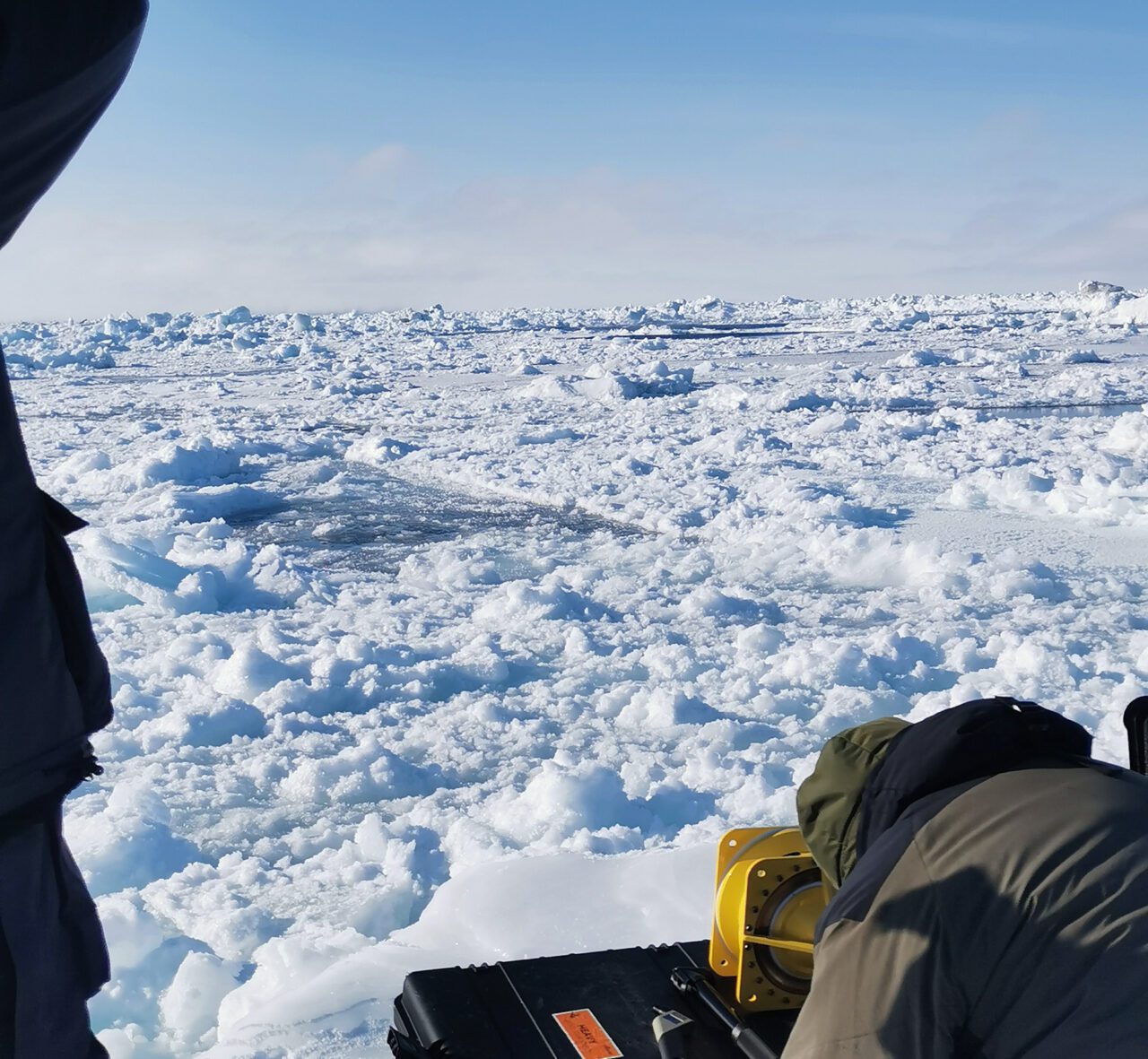
For nearly 40 years, the Cornell Lab has been pioneering ways to demystify the world’s oceans through a series of technological advances, such as marine autonomous recording units, that have enabled humans to hear the ocean environment as never before. These advances have helped stop whale collisions, enforce marine protected areas, and show scientists what is needed to protect ocean life when faced with rapid shoreline development, increased shipping traffic, and warming temperatures.
In 2022, Cornell Lab research faculty Léa Bouffaut and her collaborators discovered a brand-new way of monitoring sounds of the ocean that could be safer, more efficient, and more economical than current methods—and it’s shaping up to be a game changer for marine conservation.
Old Communications Lines Become Cutting-Edge Detectors
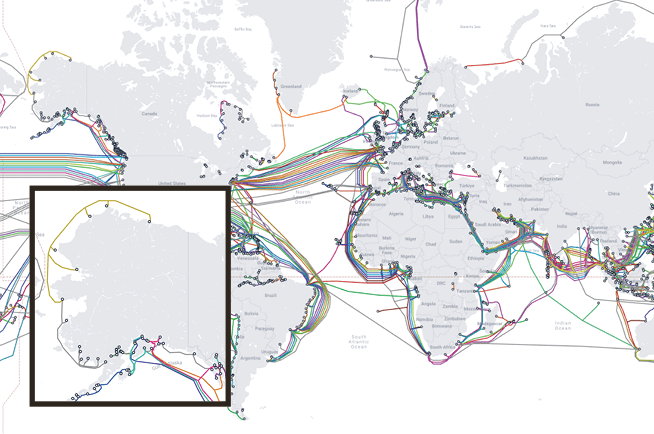
Nearly a million miles of undersea fiber optic internet cables—enough to circle the globe 40 times over—run along the ocean floor. As the years pass and new technology emerges, many of the cables outlive their usefulness to telecommunications companies. But far from becoming oceanic litter, these aging cables have a secret power: They can detect underwater vibrations. With a device called an interrogator, those vibrations can be listened to (and looked at) as sound recordings.
Fiberoptic cables have a secret power: They can detect underwater vibrations, which can be listened to (and looked at) as sound recordings.
The technology is called distributed acoustic sensing (DAS)—it’s a way of sensing strain on the cables by sending out a laser and measuring tiny movements in the fibers. “It’s like echolocation in bats,“ says Léa. “They send a click out, and it comes back from a reflection on an object. When the object moves there’s a little phase shift in the click, and that is how they’re able to understand how an object is moving. DAS is the same thing, except that instead of an acoustic signal, the interrogator sends an optical signal.”
Léa first visited the Cornell Lab in 2018 for an internship as she was developing signal-processing methods to analyze whale sounds in the Indian Ocean. She says scientists were already using DAS to measure things like seismic activity and ocean swells through fiber optic cables when she first found out about the technology. Then, in 2020, Léa was continuing her marine bioacoustic work as a postdoctoral researcher at the Norwegian University of Science and Technology, when her advisor, Martin Landrø, asked if she wanted to check fiber-optic-cable recordings from Svalbard, Norway (inside the Arctic Circle), for whale sounds.“He told me that fiber optic cables were good at detecting very low-frequency sounds, and we knew that low-frequency sounds from blue whales and fin whales show up on other seismological instruments. We thought maybe it would work for DAS too.”
It worked. Léa and her colleagues were able to detect the vocalizations of blue whales, marking the first ever use of DAS to monitor whales by way of the sounds they make.
And the marine bioacoustic world took notice. In just three years, the paper has been downloaded nearly 4,000 times, and has been cited in other published research more than 60 times. Léa recently co-led a day-long session dedicated to distributed acoustic sensing for ocean acoustics at the 188th meeting of the Acoustical Society of America in May 2025.
Innovation at the Edges of the Continent
Two projects on opposite sides of North America are demonstrating the potential wide-ranging applications for this revolutionary technology.
Off the coast of northern and western Alaska, bowhead whales are an indispensable part of the Arctic marine ecosystem. Since the 1980s, the Cornell Lab has deployed hydrophones to help the North Slope Borough conduct once-a-decade bowhead whale surveys for the International Whaling Commission.
In the Arctic, the use of hydrophones is becoming more challenging, and the need for whale monitoring is becoming more urgent, as warming oceans are prompting other whale populations—including humpback and fin whales, as well as predatory killer whales—to spend more time at higher latitudes.
“The area is ice-covered for most of the year. We have to deploy our instruments during the open water season, because the ice is not stable and predictable enough anymore to dig a hole for spring deployments,” says Léa. “When you use DAS, you don’t have to go to sea to put recorders out, [or to] pick them back up again. That’s a big financial burden, and can be quite a safety risk as well. And, DAS has the potential for near-real-time monitoring. Having the interrogator on shore reduces constraints on data storage, energy, and processing demands.”
Building on the work she did with the recordings from Svalbard, Léa and a team of partners are now using the existing fiber optic cables around the North Slope of Alaska to test how well they can detect bowhead whales, while still using hydrophones to help verify the results.
On the opposite end of the continent, the mouth of the St. Lawrence River contains the largest estuary in the world. It serves as a superhighway for whales and contains some of the most productive fisheries on the planet. Each summer baleen whales, including endangered blue whales and North Atlantic right whales, move into the area to feast in the highly productive waters.
Because the estuary narrows as the whales swim from the Atlantic Ocean toward the St. Lawrence River, it creates a bottleneck for whales, putting them at an increased risk of collisions and entanglements with cargo ships and fishing pots, respectively. Working with the University of Quebec in Rimouski, First Nations, the Canadian government, and industry partners, Léa and her collaborators are using existing fiber optic cables to explore real-time ship traffic and whale monitoring in hopes of reducing harm to the whales in the area.
A Future of Faster Conservation Action
Looking to the future, Léa sees incredible potential for DAS to be used around the world for monitoring, as well as plenty of challenges. “Storage is the main constraining factor. DAS records huge amounts of data, and we need to be able to process that data as it comes in and quickly get it into the hands of conservation decision-makers.”
Over the next few years, Léa and her team will be developing algorithms, testing the sensitivity of these cables for their effectiveness in detecting different species. “As we develop these methods and calibrate them for much larger scales, the next two to three years are going to really unlock just what we can do with this technology.”
Join Our Email List
The Cornell Lab will send you updates about birds, birding, and opportunities to help bird conservation. Sign up for email and don’t miss a thing!
Golden-cheeked Warbler by Bryan Calk/Macaulay Library